Four Neighbors, One Line, Zero Privacy: The Shared Telephone World America Forgot
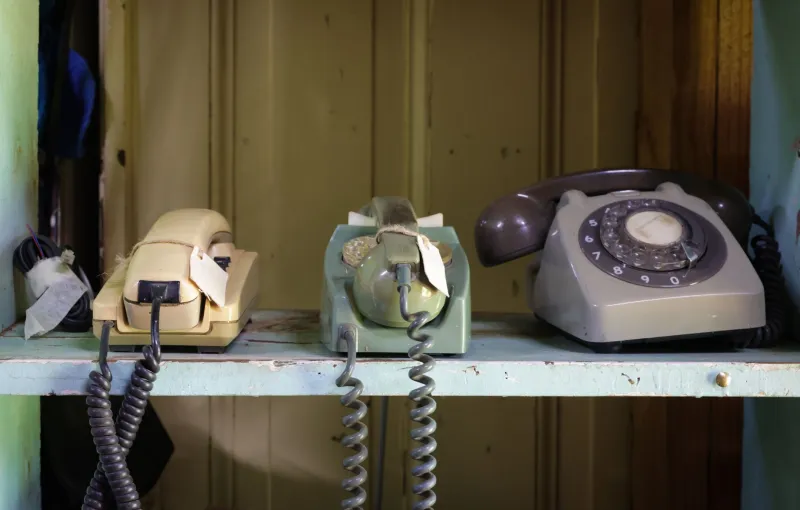
Imagine picking up your phone to make a call and hearing two of your neighbors already mid-conversation. You could hang up quietly and try again later. You could clear your throat and ask them to wrap it up. Or — and this happened more than anyone admitted — you could just listen.
This wasn't a glitch. This wasn't a security breach. This was Tuesday in rural and small-town America for most of the twentieth century, and it was called a party line.
How Party Lines Actually Worked
The mechanics were straightforward, even if the social dynamics were anything but. A party line was a single telephone circuit shared among multiple households — sometimes two, sometimes as many as eight or ten on rural exchanges. Each household had a distinct ring pattern: two short rings might mean the call was for the Hendersons, one long and one short for the Kowalskis next door. You learned to recognize your pattern the way you recognized a knock at the door.
The telephone company charged less for party line service than for a private line, which made it the practical choice for millions of families who couldn't justify the extra expense. By the 1950s, roughly a third of all American telephone subscribers were on shared lines. In rural areas, that figure was closer to two-thirds. Party lines weren't a relic of the early telephone age — they were a mainstream fixture of postwar American life, quietly persisting in many communities well into the 1970s and beyond.
To make a call, you lifted the receiver and listened first. If a neighbor was already on the line, you waited. If the line was clear, you dialed. If someone picked up mid-conversation — intentionally or accidentally — you heard them. They heard you. That was the arrangement.
The Etiquette Nobody Wrote Down
Because no official rulebook governed party line behavior, communities developed their own informal codes. Most people understood that you didn't eavesdrop deliberately, or at least that you weren't supposed to admit it. You kept your calls reasonably short so others could use the line. In emergencies — a barn fire, a medical crisis, a sudden storm — you interrupted without apology, because everyone understood that the line existed for the community, not just for you.
That last point shaped something important about how people communicated. Knowing that your conversation was technically audible to several households made you careful in specific ways. You didn't discuss money problems in detail. You didn't air marital grievances. You didn't say anything about a neighbor that you wouldn't say to their face — partly because, on a party line, you might actually be saying it to their face.
People developed a kind of verbal discretion that seems almost foreign now. Sensitive topics got handled in person, not over the phone. Gossip flowed, certainly, but with a certain awareness of consequence. If you said something unkind about Dorothy from down the road, there was a genuine chance Dorothy was listening.
The Eavesdropping That Everyone Pretended Wasn't Happening
Of course, plenty of people listened anyway. This was an open secret in most communities. Certain neighbors became known as dedicated monitors of the line — the kind who seemed to have an uncanny awareness of everyone's business. Children were sometimes stationed near the phone receiver as informal intelligence-gathering operations. Old-timers tell stories of entire community dramas unfolding through overheard calls: affairs discovered, business deals intercepted, feuds ignited by something accidentally heard and deliberately repeated.
In some ways, the party line functioned as a low-tech social surveillance system. Not a sinister one, exactly — more like a neighborhood in which the walls were thin and everyone tacitly knew it. Behavior adjusted accordingly. People were, in certain respects, more accountable to their communities because their communities were literally listening.
Privacy as a Modern Invention
Here's the contrast that tends to stop people cold: Americans in the party line era had almost no expectation of telephone privacy, and most of them accepted this as simply the nature of things. Today, the discovery that a tech company has accessed your browsing history or that an app has shared your location data triggers genuine outrage — congressional hearings, class action lawsuits, front-page stories about betrayal and violation.
We have built an entire cultural framework around the idea that our digital communications are ours alone. When that framework cracks, the reaction is visceral. And yet, for most of the twentieth century, the idea that a phone call was private was, in many American households, simply not true — and people built their lives around that reality without treating it as a crisis.
This isn't to say that digital privacy violations don't matter. They do, significantly. But the contrast reveals something interesting about how privacy expectations evolve. The party line generation didn't fight for telephone privacy because they'd never had it. Today's generation fights for digital privacy because they believed they had it, and discovered they were wrong.
When Community Meant Proximity
The party line also reinforced something that's genuinely harder to replicate in the modern era: the sense that your neighbors were real participants in your daily life, not strangers who happened to live nearby. Knowing that you shared infrastructure — a phone line, a rural mail route, a volunteer fire department — created obligations and connections that ran deeper than a neighborhood Facebook group.
You couldn't be anonymous on a party line. You couldn't ghost someone or leave a message unread. The line was live, the community was listening, and your words had weight because they landed in real time among real people who would see you at church on Sunday.
That's a world most Americans under fifty have never experienced. And whether you find it charming or suffocating probably says something interesting about what you value most.