The Man With the Matching Books: When Knowledge Came to Your Front Door
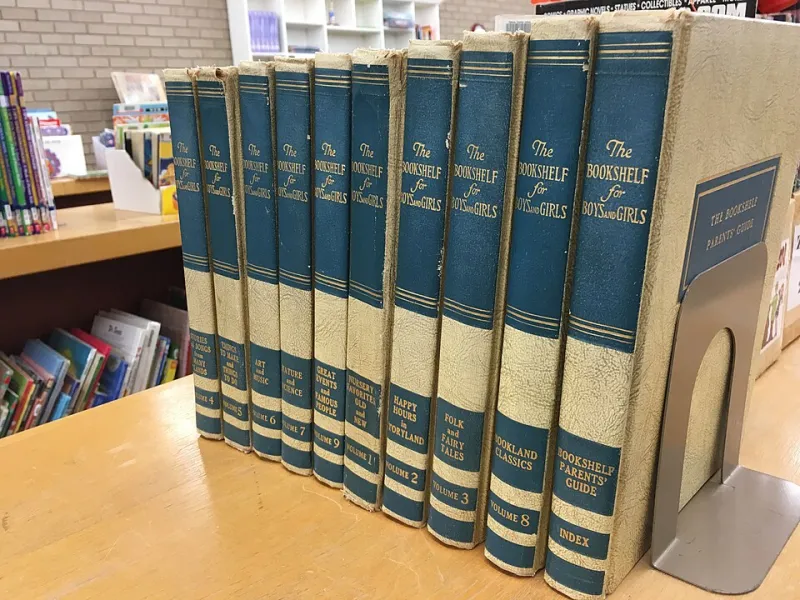
Photo: Texas State Library and Archives Commission from Austin, TX, United States, CC BY 2.0, via Wikimedia Commons
He rang the doorbell on a weekday evening, briefcase in hand, and by the time he left two hours later, your parents had signed up for a payment plan that would run for the next eighteen months. In exchange, a set of matching hardcover volumes — twenty or thirty of them, depending on the edition — would arrive at your house and take up a dedicated shelf in the living room.
This was the encyclopedia salesman. And for a significant stretch of American life, his visit represented something families took genuinely seriously: the idea that knowledge was worth paying for, that having it in the house mattered, and that children who grew up with it would have an advantage over those who didn't.
The Shelf That Said Something About You
Owning a full set of encyclopedias wasn't cheap. Britannica, World Book, Collier's, Americana — the major sets could run anywhere from a few hundred to over a thousand dollars, a serious sum in mid-century America. Many families bought them on installment plans, paying monthly the way they might pay for a new appliance.
And like a new appliance, the encyclopedia set was a household investment. It got displayed. The spines faced outward. Guests could see it. There was no small amount of social signaling in that shelf — it said that this was a family that valued learning, that took their children's education seriously, that planned ahead.
But it wasn't purely performance. Those books got used. Kids dragged the relevant volume off the shelf for school reports. Parents settled dinner table arguments by going to look something up. The act of consulting the encyclopedia — finding the right volume, locating the entry, reading through until you found what you needed — was a skill in itself, and most kids of that era practiced it regularly.
The Authority of the Printed Page
Here's something worth understanding about how those encyclopedias worked: they were curated by experts. Editors, subject specialists, and academics decided what went in, how it was framed, and how much space each topic deserved. When you read the entry on the American Civil War or the solar system or the history of jazz, you were reading something that had been written, reviewed, and approved by people whose job was to get it right.
That gave the information a particular kind of authority. It wasn't infallible — encyclopedias had their own biases and blind spots, and the information aged quickly — but there was a clear chain of accountability behind every entry. Someone had decided this was accurate enough to print and sell.
The flip side of that authority was limitation. Your encyclopedia was fixed the moment it was printed. Events that happened after publication weren't in there. Discoveries made last year weren't reflected. Many families bought annual yearbook supplements specifically to address this problem, filling in the gaps with thin companion volumes that arrived by mail.
The Homework That Required Actual Effort
For kids growing up in the encyclopedia era, research was a physical process. You went to the shelf, pulled the right volume, and read. If your home set didn't have what you needed, you went to the school library or the public library, where the reference section held larger and more specialized collections.
This friction had consequences. You couldn't look up seventeen things in five minutes. A research project required time, physical effort, and navigation through material that wasn't always perfectly organized. Sometimes you found what you were looking for. Sometimes you found something adjacent that turned out to be more interesting.
That last part is underappreciated. The experience of browsing an encyclopedia — following a cross-reference, getting sidetracked by an interesting entry on the same page, discovering that the topic you were researching connected to something you'd never considered — produced a kind of accidental learning that's genuinely hard to replicate with a search bar that takes you directly to exactly what you asked for.
When Google Made It All Irrelevant
The encyclopedia industry didn't decline slowly. It collapsed. Encarta, Microsoft's CD-ROM encyclopedia, undercut the printed sets on price in the early 1990s and began shifting the format to digital. Then the internet arrived in American homes at scale, and by the early 2000s, the market for printed encyclopedias had essentially ceased to exist. Britannica printed its last physical edition in 2012. Wikipedia, launched in 2001 and built by volunteers, had by then become the world's de facto reference library.
The transformation was staggering in scope. Information that once cost hundreds of dollars and took up three feet of shelf space became free, searchable, and available on a device that fit in a pocket. Every question answerable in seconds. Every topic connected to dozens of others. The constraint that had defined how Americans accessed knowledge for generations was simply gone.
What the New System Costs
Free and infinite comes with its own complications. Wikipedia is genuinely remarkable — vast, frequently updated, and more accurate than its critics often acknowledge. But it also operates without the editorial gatekeeping that made those encyclopedia entries feel settled. Anyone can edit a Wikipedia article. Errors get corrected, but they also get introduced. The chain of authority is distributed and sometimes murky.
More broadly, the shift from curated to searchable changed something about how Americans relate to information. When knowledge required a significant financial investment and came from a clearly identified source, there was a certain weight to it. You didn't dismiss what the encyclopedia said just because you didn't like it. The authority felt real because it had been paid for.
Today, the information landscape is so wide and so contested that many people simply find sources that confirm what they already believe and treat those as authoritative. The encyclopedia salesman's pitch — that organized, expert-curated knowledge was worth spending real money on — seems almost quaint now. But buried inside that pitch was something worth examining: the idea that not all information is equal, and that someone has to be responsible for deciding what's reliable.
Those matching spines on the living room shelf weren't just books. They were a household's declaration that facts mattered enough to invest in.