The Little Yellow Envelope: What Waiting a Week for Your Photos Actually Taught You
You handed over your film canister at the drugstore counter, received a small paper ticket in return, and then you waited. Five to seven business days, usually. Sometimes longer. And during that stretch of time, you had absolutely no idea what you'd actually captured.
Maybe you'd shot a birthday party two weeks ago and a beach weekend the following Saturday — both on the same roll. Maybe you'd accidentally double-exposed a frame somewhere in the middle. Maybe the last eight shots were taken in dim light at an indoor reception and would come back as nothing but muddy shadows. You wouldn't know until you knew. That was the deal.
For anyone who grew up shooting film, that little yellow Kodak envelope — or the white Fuji equivalent — carries a specific emotional weight that's almost impossible to explain to someone who grew up with a camera in their phone. It wasn't just a way to get your pictures back. It was an event.
The Ritual of the Roll
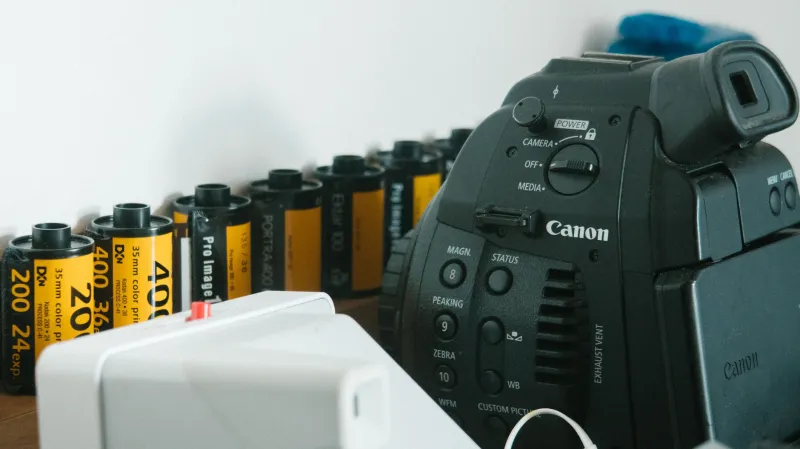
Film photography had a built-in economy of attention that digital never needed. A standard roll gave you 24 or 36 exposures, and that was your entire budget. You didn't spray-and-pray — you couldn't afford to, literally. Each click of the shutter was a small expenditure, and you thought about it accordingly.
At a wedding or a graduation, someone with a camera was making real decisions in real time. Is the light good enough? Is this moment worth one of my remaining frames? Should I wait for a better angle? Those weren't aesthetic questions born from artistic ambition — they were practical ones, forced by constraint. And that constraint, almost accidentally, produced a certain quality of attention.
You were present in a way that's genuinely harder to sustain when you know you can take 400 photos and delete 390 of them later. The camera came out for the moments that seemed to matter, and it went back in the bag when the moment passed. Nobody was photographing their lunch. Nobody was taking seventeen nearly identical shots of the same sunset to find the best one.
The Wait Itself
Dropping off a roll and waiting a week sounds, by modern standards, like a form of mild torture. And yes, there was impatience involved — especially when you'd shot something you were excited about and had to wait days to see whether it worked.
But the wait did something interesting to memory. By the time you picked up your prints, you'd already processed the experience emotionally. You remembered the party, the trip, the family visit — not as a scroll of images to be catalogued, but as something you'd actually lived through. When the photos arrived, they weren't replacing the memory. They were landing inside it, adding detail to something already stored.
There was also genuine surprise. Roll up to a photo pickup counter enough times and you understood: the pictures were never exactly what you thought you'd taken. The shot you were certain was perfect had someone blinking. The one you almost didn't take turned out to be the best frame on the roll. Film had its own opinions, and it expressed them after the fact, in the privacy of a darkroom you'd never see.
That surprise created a different relationship with photography. You weren't curating in real time. You were discovering.
What Happened to the Photos After
Prints meant physical objects. And physical objects needed somewhere to live.
American households in the film era accumulated photo albums in a way that has largely stopped. Not because people stopped caring about their memories, but because digital photos exist in a kind of permanent limbo — technically saved, practically invisible, living on hard drives and cloud servers that nobody opens unless they're looking for something specific.
The photo album was a different kind of archive. It was curated by necessity — you had 36 prints, you couldn't keep all of them, so you chose. The blurry ones went in the trash. The duplicates got mailed to grandma. What remained was a genuine edit, a selection that represented not just what happened but what seemed worth preserving.
Sitting down with a photo album was a social act. You'd flip through it together, pointing at people, laughing at haircuts, asking who took this one. The album lived on a shelf and could be pulled out at any time without a password, a charging cable, or a subscription service.
The Paradox of Infinite Photos
Today, the average American smartphone holds thousands of photos. Possibly tens of thousands. Most of them will never be printed, never be organized, never be looked at again after the week they were taken. The storage is cheap, so nothing gets deleted. The result is an archive so large it becomes effectively invisible.
This isn't a failure of technology — it's a side effect of abundance. When photographs cost something, in money and in attention, each one carried more weight. When they're free and instant and infinite, the individual image loses meaning even as the total collection grows.
There's also the preview problem. The moment you take a digital photo, you see it. The loop closes instantly. That immediacy is genuinely useful — you can check focus, adjust composition, retake a shot that didn't work. But it also eliminates the gap between capturing a moment and seeing it, and something lives in that gap. Anticipation. Uncertainty. The particular pleasure of not knowing yet.
What the Yellow Envelope Understood
Film photography didn't just document life — it asked you to slow down long enough to decide what was worth documenting. The wait wasn't a flaw in the system. It was, in retrospect, one of its most quietly valuable features.
You can't recreate it with an app or a filter or a deliberate decision to shoot less. The constraint was real, and the behavior it produced was a response to real constraint. But you can at least recognize what it gave people: a more deliberate eye, a more patient relationship with memory, and the small recurring joy of opening an envelope and finding out what you'd actually seen.