Stamped, Signed, and Yours: The Small Book That Made Saving Money Feel Real
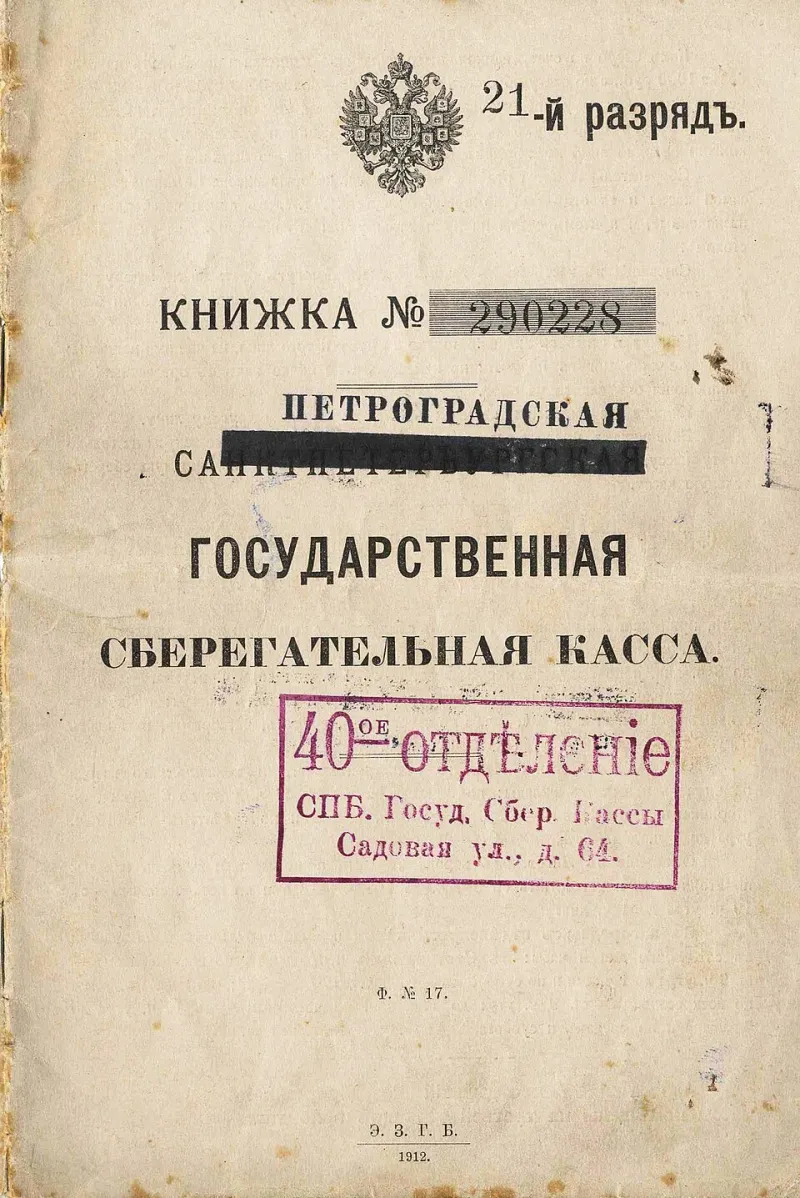
Photo: Saint Petersburg/Petrograd State Savings Bank; printed form by the Expedition for the Preparation of State Papers (Э. З. Г. Б.). Individual designers and writing officials are not identified., Public domain, via Wikimedia Commons
The Book in the Drawer
Ask anyone over sixty where their savings passbook is, and you may get a small pause — the kind that means they know exactly which drawer it's in, and it's still there.
It was a slim booklet, usually blue or green, sometimes with the bank's name embossed in gold that had worn off at the corners. Your account number was typed inside the cover. And every time you made a deposit, a teller fed it into a machine that printed a line and stamped it with a date, so that the history of your money became something physical, in your own handwriting and someone else's ink.
Tracking your savings didn't mean opening an app. It meant opening the book.
The Ritual at the Counter
A trip to the bank was an errand with a rhythm to it. You filled out a deposit slip — the small, stiff rectangle with carbon paper tucked behind it — in the lobby, standing at a counter with a chained pen. Then you joined the line.
The lobby itself told you something about the seriousness of the enterprise. Marble, tall ceilings, brass fixtures, a guard who nodded at you. Banks in midcentury America were built to feel like courthouses, and the message was clear: this is a place where important things are kept.
When you reached the window, the teller took your book and your cash, counted the bills twice without appearing to, and slid the passbook into a printer that whirred and clacked. The stamp came down. You checked the number. Then the book went back into your purse or your jacket pocket, and you walked out feeling a small, specific satisfaction that is genuinely difficult to describe to anyone who has only ever seen a balance refresh on a screen.
Why the Paper Mattered More Than the Money
Here's the thing people forget: a passbook was not just a record. It was a narrative.
You could flip back through the pages and see the summer you worked two jobs. You could see the $25 you put in the week after your daughter was born, and the withdrawal for the refrigerator, and the slow, stubborn climb back up afterward. The book recorded not just what you had, but what you had done.
Children were often given their own passbooks, sometimes with a first deposit of a dollar or five, as a lesson in how money grows. They'd bring in their birthday cash and watch it get stamped, and the concept of interest — that money could quietly make more money — became visible as a column of numbers that grew without you doing anything. That is a powerful idea to hand a nine-year-old in a booklet they can hold.
Then the Number Started Living Somewhere Else
Automation crept in gradually. First came the ATM, which could take a deposit but couldn't print in your book. Then came monthly statements mailed to your house. Then telephone banking, and finally the screen — the balance that appears the second you open an app, updated in real time, no teller, no stamp, no walk through a marble lobby.
The convenience is not debatable. You can move money at 11 p.m. from a parking lot. You can set an automatic transfer and forget it exists. Nobody misses standing in line on a Saturday morning.
But something changed in the way we relate to the number. When your savings lived in a book, you saw it maybe twice a month, and every visit was a small event. When it lives in an app, you can see it forty times a day, which means you see it mostly in passing — a glance while you're waiting for a text to send.
The Psychology of a Stamp
Psychologists who study saving behavior have long noted that friction, oddly, can help. Money that is slightly harder to reach is money that stays put. The passbook had natural friction built in: it was a physical object, kept in a drawer, requiring a trip and a conversation to change.
Today's automation removed the friction entirely, which is wonderful for building a habit and terrible for building a feeling. An automatic transfer happens in the background and you never see it. It grows your balance without ever giving you the moment of pride that came with sliding a book across the counter and watching the total go up.
The Drawer Still Exists
Some community banks and credit unions still offer passbook accounts, mostly for older customers and kids, and they're usually the ones with the longest lines at the teller windows. That's not an accident. Those customers aren't there because they can't use an app. They're there because the app doesn't do the thing the book did.
It made saving feel like an accomplishment you could hold in your hand and flip back through.
The balance on your phone is a fact. The passbook was a story, told one stamp at a time, and it turns out that most of us save better when we're writing something down.