From the Card Catalog to the Infinite Scroll: How America Learned to Find Anything
The Room That Held All the Answers
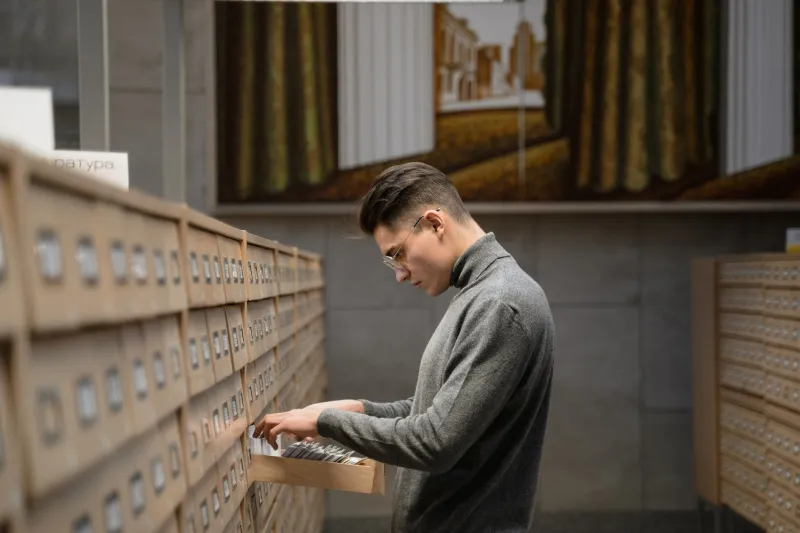
Picture a Tuesday afternoon in 1974. You're a high school junior in Ohio with a history paper due Friday. You grab your bike, ride to the public library, and walk through those heavy glass doors into a hush that feels almost ceremonial. The card catalog — rows and rows of small wooden drawers, each stuffed with typed index cards — stands at the center of the room like an altar.
You flip through the cards with your fingers, smelling that particular dusty paper smell, copying down call numbers in pencil on a little slip. Then you hunt the stacks. Maybe you find the book you need. Maybe it's checked out. Maybe the librarian at the reference desk, a woman named Mrs. Kowalski who has worked there for twenty-two years and knows the collection like a second language, steers you toward something better. Maybe you leave with three books, two of which turn out to be dead ends, and one of which changes how you think about the subject entirely.
That was how America found things out. It was slow. It was physical. And it was, in ways we're only now starting to reckon with, genuinely good for you.
The Encyclopedia on the Shelf
For families who could afford it, the home encyclopedia set was a mark of seriousness — a declaration that learning mattered here. Salesmen went door to door in postwar suburbs selling the World Book or Britannica in multi-volume sets that cost the equivalent of several hundred dollars and arrived in a box like something sacred.
These books were, by definition, already a little out of date the day they were printed. They were curated by editors, reviewed by experts, and written to a standard. If you looked something up in Britannica, you could be reasonably sure it had passed through multiple layers of scrutiny before landing on your lap.
The limitation, of course, was scope. You knew what the editors decided was worth knowing. Everything else — the obscure, the niche, the genuinely weird corners of human knowledge — simply wasn't there.
The Moment Everything Changed
The public internet arrived in American homes gradually through the 1990s, and for the first few years it felt more like a novelty than a revolution. Search engines were clunky. Results were unreliable. You still called the library sometimes.
Then Google happened. Then Wikipedia. Then smartphones. And somewhere between 2005 and 2010, the entire project of human information-sharing crossed a threshold that would have been unimaginable to that kid on the bike in 1974.
Today, a twelve-year-old in rural Mississippi has faster access to more reliable information than any university library offered thirty years ago. The collected works of Shakespeare, the full text of the U.S. Constitution, peer-reviewed medical studies, satellite imagery of any street on earth — all of it, searchable, in seconds, from a device that fits in a coat pocket.
The numbers are almost too large to process. Google processes roughly 8.5 billion searches every single day. Wikipedia hosts over 60 million articles across hundreds of languages. The Library of Congress, the largest library on earth, holds about 17 million books. The internet makes that look like a corner store.
What We Gained
The gains are obvious and enormous. Democratization of knowledge is the phrase people use, and it's earned. Information that once required institutional access — medical research, legal documents, financial data — is now available to anyone with a Wi-Fi connection. Small-business owners can now research competitors, file permits, understand tax codes, and market their services without hiring a team of specialists. First-generation college students can navigate applications without a guidance counselor who's seen it all before. Patients can walk into their doctor's office with actual questions instead of just anxiety.
Speed matters too. When a water pipe bursts at midnight, you don't wait until the library opens. You find a plumber, watch a YouTube tutorial, and understand your options inside of four minutes. That's not trivial. That's a genuine improvement in how people move through their lives.
What We Lost in the Stacks
But something went with the card catalog that's worth naming honestly.
The old way of finding information had friction built into it, and friction, it turns out, had value. When you had to physically go somewhere and search deliberately, you were forced to commit to a question. You had to decide what you actually wanted to know before you started looking. That act of committing — of formulating a real question — did cognitive work that the search bar now skips entirely.
There was also the serendipity of the stacks. You'd pull the book you needed and notice, on the same shelf, a book you didn't know existed that turned out to be exactly what you were looking for in a deeper way. Librarians called it browsing, and it produced a kind of discovery that algorithms struggle to replicate. An algorithm gives you what you already want. The stacks gave you what you didn't know you needed.
And then there's the quality problem. The encyclopedia was curated. The internet is not. Today's information environment delivers accurate science and dangerous misinformation through the same interface, with the same confidence, in the same font. The card catalog never lied to you about whether a source was peer-reviewed. The search results don't tell you that either — not clearly, not reliably.
We also lost depth. Studies consistently show that people who read on screens read faster and retain less than people who read on paper. The scroll has made us brilliant at skimming and worse at sitting with something long enough to actually understand it.
The Librarian We Stopped Calling
Mrs. Kowalski knew things that weren't written anywhere. She knew which local history books had errors in them. She knew that the author of a particular biography had a personal grudge against the subject. She knew that if you were researching labor history, there was a specific collection in the back room that most people never found.
That kind of knowledge — contextual, relational, built over decades — doesn't have a search query. It doesn't have a URL. It lived in people, and when the libraries got quieter and the reference desk got less busy, some of it just quietly disappeared.
Finding Your Way in Both Worlds
None of this is an argument for going back. The democratization of knowledge is one of the genuine achievements of the last thirty years, and the idea of restricting access to information to those with library cards and encyclopedia budgets is not romantic — it's regressive.
But there's something worth holding onto from the old way. The deliberateness. The commitment to a real question. The willingness to sit with a physical book long enough for it to actually change how you think.
The library is still there. Mrs. Kowalski may have retired, but her successors are still behind the reference desk, still knowing things the algorithm doesn't. Maybe the wisest thing we can do with all this infinite access is occasionally choose to slow down and use it like we used to — on purpose, with patience, and without the scroll.