Nobody Blew the Whistle: The Unruly, Ungoverned Hour That Taught Kids Everything
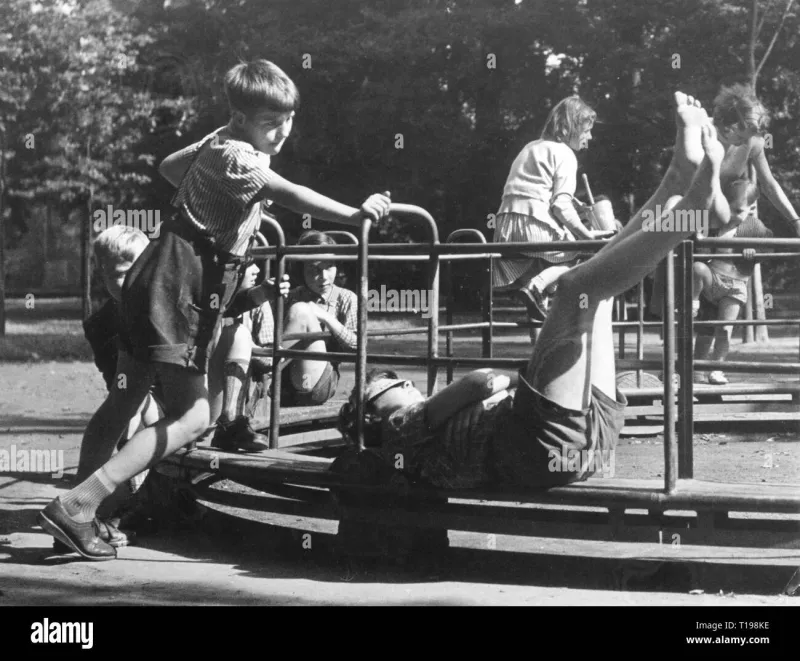
Photo: children playing unsupervised school recess playground 1960s 1970s black and white, via c8.alamy.com
The bell rang, the doors flew open, and several hundred children poured out onto a blacktop or a grass field with almost no adult structure waiting for them. Maybe a teacher stood near the door, vaguely watching. Maybe there was a yard monitor who intervened if things got genuinely dangerous. But mostly, for thirty or forty-five minutes in the middle of the school day, kids were on their own.
They formed teams without a coach. They argued about the rules of games and eventually reached some kind of agreement, or they didn't and the game fell apart and they started a different one. Somebody got pushed. Somebody cried. Somebody got back up. The bell rang again, and they all went inside, slightly dirtier and marginally wiser about how people worked.
That was American school recess for most of the twentieth century. And it was, in ways that took decades to fully appreciate, one of the most educational parts of the school day.
What Recess Used to Actually Look Like
In the mid-century American school — say, 1955 to 1975 — recess was a largely unscripted block of time. Equipment was minimal: maybe a swing set, a tetherball pole, a painted four-square grid on the blacktop. The rest was improvised. Kids played tag, kickball, marbles, jump rope, and dozens of regional variations of games that existed nowhere in any official rulebook.
Crucially, children made the rules themselves. If there was a dispute about whether someone was out in kickball, there was no adult to appeal to. You argued it out, you negotiated, you accepted a compromise, or you walked away in a huff and found something else to do. These were not trivial social exercises. Learning to argue your case, read a crowd, know when to push and when to concede — these are skills that take years to develop, and recess was one of the primary places they got built.
Physical risk was also just part of it. Monkey bars over concrete were standard equipment at American schools well into the 1980s. Kids climbed to the top of things and jumped off. Scraped knees and bruised elbows were normal, expected, not particularly alarming. Parents didn't get phone calls about minor injuries. You got up, maybe cried for thirty seconds, and kept playing.
The Shift Toward Structured, Supervised Play
Beginning in the late 1980s and accelerating sharply through the 1990s, American schools began rethinking recess. The drivers were multiple and, individually, each made a kind of sense.
Liability concerns pushed school districts to remove equipment deemed too dangerous — those concrete-footed metal jungle gyms gave way to rubberized, lower-to-the-ground plastic structures. Injury lawsuits were expensive, and the safest legal posture was to eliminate the conditions that produced injuries.
Bullying awareness, which grew significantly as a public concern during this period, led to more adult presence on playgrounds. If adults were watching, the logic went, bullying would be caught and stopped. That was true, to a point. But it also meant that children stopped being required to manage social conflict on their own terms.
Academic pressure played a role too. As standardized testing became more central to school funding and teacher evaluation through the late 1990s and 2000s, recess in some districts was shortened or eliminated to create more instructional time. Some elementary schools reduced recess to fifteen minutes. A handful cut it entirely.
By the 2010s, many American schools had replaced free-play recess with structured activities led by adults. Games with assigned rules. Organized sports with coaches. "Social-emotional learning" exercises facilitated by a counselor. The intent was good. The result was a recess that looked almost nothing like what it had been.
What the Research Actually Found
Here's where it gets complicated, because the research on unstructured play has been fairly consistent — and it doesn't entirely support the direction American schools took.
Studies in developmental psychology have repeatedly found that unstructured, child-directed play is critical to the development of executive function: the ability to regulate emotions, set goals, manage frustration, and think flexibly. When children make up their own games, they're not just playing — they're practicing abstract thinking, negotiation, and self-regulation in real time.
Pediatric researchers including Stuart Brown, who wrote extensively on play science, and the authors of multiple American Academy of Pediatrics policy statements have argued that the reduction of free play in American childhood correlates with rising rates of anxiety, depression, and difficulty with independent decision-making in children and adolescents. The AAP formally recommended in 2018 that pediatricians write prescriptions for play — an extraordinary statement about how far the pendulum had swung.
 Photo: American Academy of Pediatrics, via www.smartstart.org
 Photo: Stuart Brown, via pactcreative.com
Risk, too, turns out to matter more than the liability-minimizing instinct suggested. Researchers studying "risky play" — climbing, rough-and-tumble games, activities with a genuine chance of minor injury — have found that children who engage in it develop better risk assessment skills and lower rates of anxiety than those raised in highly protected environments. Scraping your knee teaches you something about consequences that no adult explanation fully replicates.
The Honest Trade-Off
None of this means the old recess was perfect. Bullying was real and often went unchecked. Kids who were physically weaker or socially awkward could have genuinely miserable experiences on an unsupervised playground, and there were no systems in place to help them. The freedom that benefited confident, socially capable kids sometimes came at the direct expense of those who weren't.
And some of the changes were straightforwardly good. Removing equipment that caused serious head injuries wasn't excessive caution — it was reasonable. Better anti-bullying policies, applied thoughtfully, protect real children from real harm.
But the wholesale transformation of recess from a child-governed space into an adult-managed program removed something that couldn't easily be replaced elsewhere in the school day. The negotiation, the conflict, the minor physical risk, the experience of being responsible for your own time — these weren't side effects of old-fashioned recess. They were the curriculum.
The blacktop used to be a place where kids learned, mostly by failing and recovering, how to be people. That's harder to engineer than a rubberized play structure. And so far, we haven't found a good substitute for simply letting children loose and seeing what they build.