When Every Fact Was a Treasure Hunt: The Lost World of Student Research Before Search Engines
Picture this: It's 1987, and you've just been assigned a research paper on the Industrial Revolution. Your teacher wants five sources, and Wikipedia won't exist for another 14 years. Google is just a funny word that doesn't mean anything yet. So what do you do?
You pack a bag, grab some quarters, and prepare for what could be an all-day expedition to the library.
The Card Catalog: Your Only Map to Knowledge
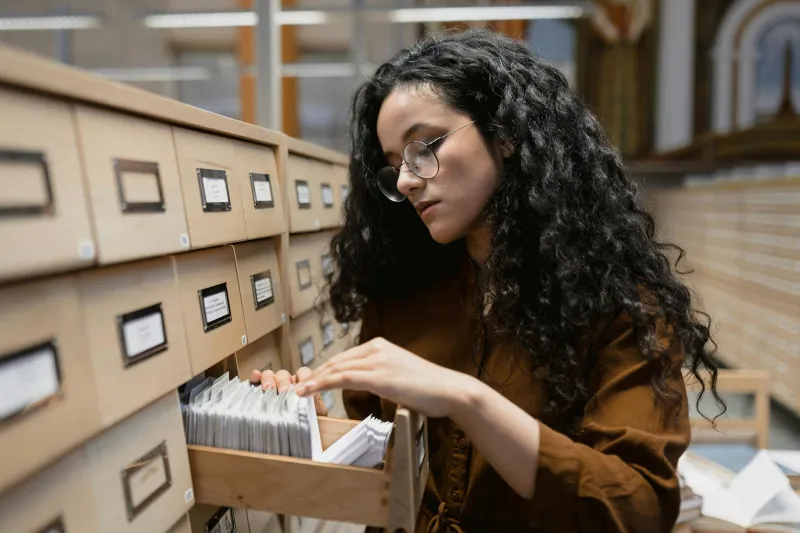
Every research journey began the same way — standing in front of a wall of wooden drawers filled with index cards. The card catalog was the Google of its time, except it was alphabetical, physical, and absolutely unforgiving. Miss a key term? You might miss the perfect source entirely.
Students became experts at thinking like librarians, brainstorming every possible way a topic might be filed. Industrial Revolution could be under "I" for Industrial, "R" for Revolution, "H" for History, or maybe "E" for Economics. Each drawer you pulled was a gamble, and each card you found was a small victory.
The really savvy students learned to work backward from the bibliography of one good book to find others. It was detective work, pure and simple.
The Encyclopedia Expedition
Once you'd identified your sources, the real treasure hunt began. Encyclopedia Britannica was the gold standard — 32 volumes of human knowledge sitting on a shelf, if you were lucky enough to find a complete set. But here's what today's students can't imagine: you couldn't just bookmark the page and come back later.
You had to copy everything by hand. Every quote, every date, every statistic was transcribed in careful handwriting into spiral notebooks. Some libraries had photocopiers, but at 10 cents a page, copying an entire encyclopedia entry could cost you lunch money for a week.
And God help you if someone else was using Volume 15 when you needed it. You'd have to wait, or come back another day, or completely reorganize your research strategy around what was available.
The Microfiche Machine: Technology That Felt Like Magic
For newspaper articles and academic papers, there was microfiche — tiny photographs of documents that you'd feed into a machine that looked like it belonged on the Starship Enterprise. The learning curve was steep: too much magnification and you'd lose the text, too little and you couldn't read it.
Finding the right frame on a microfiche card was like searching for a needle in a haystack, except the haystack was the size of a playing card and the needle was a single article from the Chicago Tribune, March 15, 1952. Students would spend hours scrolling through months of newspapers, their eyes burning from staring at the glowing screen.
When Librarians Were Superheroes
In this analog world, librarians weren't just book organizers — they were information wizards. A good librarian could point you toward sources you never would have found on your own. They knew which databases existed, which reference books were hidden in the back stacks, and how to navigate the mysterious world of interlibrary loans.
If your local library didn't have what you needed, a librarian could request it from another library. The catch? It might take two weeks to arrive, assuming it arrived at all. This meant students had to plan their research timelines like military operations.
The Social Nature of Information Gathering
Research wasn't a solitary activity. Libraries were social spaces where students would trade tips about good sources, warn each other about books that were checked out, and form informal study groups around the big tables in the reference section.
You'd recognize the other serious researchers by their stacks of notebooks, their collection of library books with paper bookmarks sticking out at odd angles, and the slightly desperate look in their eyes as a deadline approached.
When Facts Had Weight — Literally
Every piece of information had physical presence. A research paper meant a backpack full of heavy books, a folder stuffed with photocopied articles, and notebooks filled with handwritten notes. Students developed strong backs and organizational systems out of necessity.
Losing your research notes wasn't just inconvenient — it was catastrophic. There was no "search history" to recreate your steps, no bookmarks to click. If you lost that notebook with three weeks of research, you started over from scratch.
The Patience That Built Character
Perhaps most striking to modern students would be the sheer patience required. Research wasn't something you could knock out in an evening. It was a weeks-long process that required planning, persistence, and the ability to work with whatever information you could find, not necessarily the exact information you wanted.
Students learned to be resourceful in ways that seem almost quaint now. They'd check multiple libraries, ask professors for reading recommendations, and even write letters to experts in their field, hoping for a response that might never come.
The Information Revolution We Take for Granted
Today, a student can access more information in five minutes than their 1987 counterpart could gather in a month. The transformation isn't just about speed — it's about the fundamental relationship between curiosity and satisfaction.
In the pre-internet era, every fact was earned through effort. Information had value precisely because it was hard to find. The research process itself taught skills that went far beyond the topic at hand: patience, organization, critical thinking about sources, and the ability to work within constraints.
When we marvel at how much the world has changed, we often think about smartphones and social media. But perhaps nothing has transformed daily life more dramatically than the shift from information scarcity to information abundance. The student researcher of 1987, armed with nothing but a library card and determination, inhabited a fundamentally different world — one where knowledge was a treasure that had to be hunted, not summoned.