Lost on Purpose: The Glorious Chaos of the American Road Trip Before GPS Took the Wheel
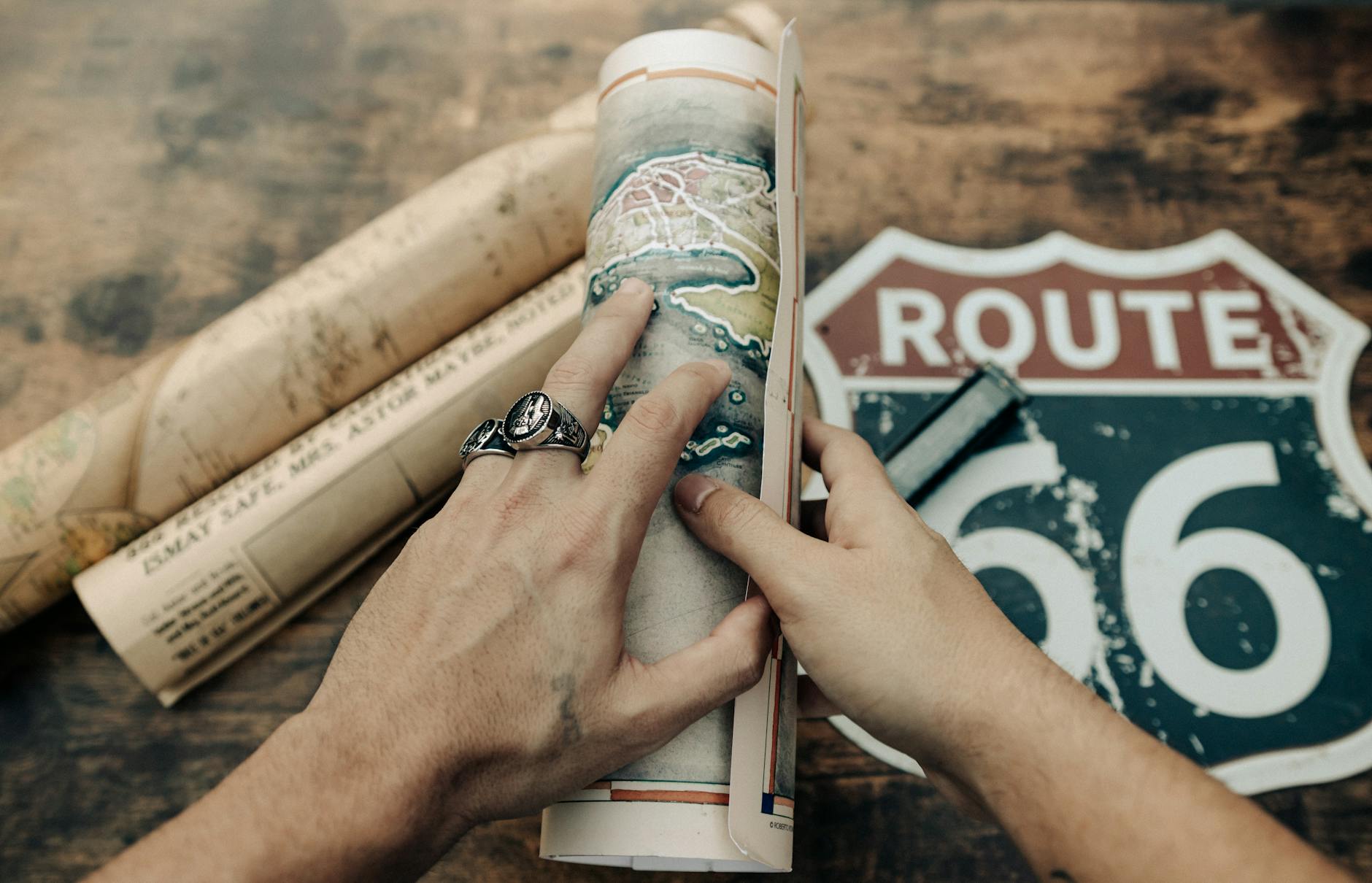
Lost on Purpose: The Glorious Chaos of the American Road Trip Before GPS Took the Wheel
Somewhere in a junk drawer, a glove compartment, or a dusty box in a garage, there's probably a folded road map that hasn't been opened in fifteen years. Creased along the same lines so many times that the paper is nearly translucent at the folds, marked with a faded highlighter route that someone — maybe you, maybe your dad — traced out the night before a long drive. That map is a relic now. But it's also a document of a completely different way of moving through the world.
The American road trip didn't disappear when GPS arrived. But it changed in ways that are worth paying attention to.
The Pre-GPS Ritual
Anyone who took a serious road trip before the mid-2000s knows the pre-departure routine. You pulled out the Rand McNally atlas — that thick, spiral-bound bible of American roads — and you planned. You traced your route with a finger, wrote the highway numbers on a notepad, estimated drive times based on nothing more than mileage and optimism, and argued with your travel companion about whether to take I-40 or cut through on the state routes.
If you were lucky, someone had called AAA and ordered a TripTik — a personalized, spiral-bound booklet of maps that showed your exact route in segments, with notes about construction zones and points of interest. It was the gold standard of pre-trip preparation, and people treated it like a treasure.
Then you got in the car and hoped for the best.
Gas Stations Were Information Centers
The gas station played a role in American road travel that's almost impossible to explain to someone who grew up with Google Maps. It wasn't just fuel. It was intelligence. You pulled in, and if you were in unfamiliar territory, you asked the attendant — or later, the cashier — for directions. And you got them in the form of landmarks, not coordinates.
"Go down this road about four miles until you see the old grain elevator, then hang a left at the blinking light. You'll pass a Methodist church — don't turn there, that's a mistake everyone makes — and then you'll see the sign."
Those directions were sometimes brilliant and sometimes catastrophically wrong. But they were human. They came with local knowledge, regional accent, and the occasional unsolicited opinion about the best diner in the next county.
Getting lost wasn't a system failure. It was part of the operating conditions.
The Particular Joy of Being Genuinely Lost
Here's something that sounds strange to say out loud: getting lost on a road trip used to produce some of the best moments of the trip.
You'd miss a turn, end up on a county road you'd never heard of, and stumble into a small town that wasn't in any guidebook. You'd find a roadside barbecue spot with a hand-painted sign and a line out the door at 11 a.m. on a Tuesday. You'd stop at a roadside attraction — the world's largest ball of twine, a painted water tower, a dinosaur statue outside a truck stop — because it was simply there and you had no algorithm telling you to skip it.
The detour wasn't a problem to be solved. It was the story you told when you got home.
There's a reason so much American literature, music, and film is built around the open road as a metaphor for freedom and self-discovery. Jack Kerouac wasn't writing about following optimized routes. The whole mythology of the American road trip was constructed around the idea that you didn't entirely know where you were going, and that was exactly the point.
What GPS Did to the Road Trip
Navigation apps are, objectively, remarkable. Google Maps and Waze can route you around accidents in real time, calculate your arrival time to within minutes, and surface fuel stops, restaurants, and rest areas exactly when you need them. They have saved countless hours, prevented countless wrong turns, and probably prevented a fair number of genuine emergencies.
But they also made the road trip into something closer to a logistics exercise.
When your route is fully optimized before you leave the driveway, and a voice in your dashboard tells you exactly when to turn, the journey becomes primarily about execution. You're not navigating — you're following. The road isn't something you're reading and interpreting; it's something you're being guided through.
The serendipity gets engineered out. The detour becomes a deviation from the plan rather than an invitation. The small town you would have stumbled into stays invisible because you're on the fastest route and the algorithm didn't flag anything worth stopping for.
Something Worth Keeping
None of this is an argument for throwing your phone out the window and buying a 1997 Rand McNally. GPS is useful, and being genuinely lost in an unfamiliar place at night with no way to get your bearings is not romantic — it's stressful.
But there's something worth preserving from the pre-GPS road trip mindset: the willingness to be surprised. To take the exit that looks interesting. To ask a person for directions instead of a satellite. To let the road be a little bit unpredictable.
The best road trips have always been the ones where something unplanned happened. GPS didn't take that possibility away entirely. It just stopped building it into the design.
Maybe the open road is still out there, waiting. You just have to be willing to close the app every once in a while.