Eight Families, One Phone Line: When Privacy Was a Luxury Americans Couldn't Afford
In an era when Americans worry about their smart speakers listening in and their phones tracking every movement, it's almost impossible to imagine a time when privacy wasn't just compromised—it was completely nonexistent. Yet for millions of American families well into the 1970s, every phone conversation was a potential community event, thanks to a system that seems unthinkable today: the party line.
Welcome to the Neighborhood Network
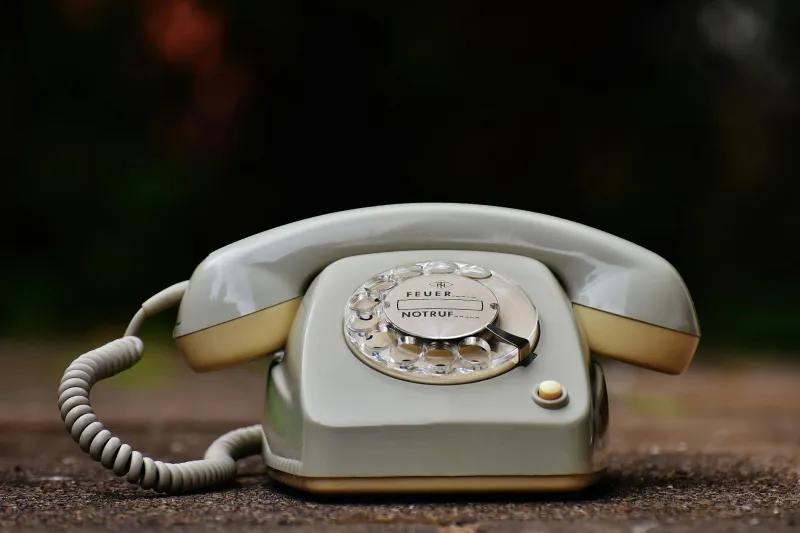
Picture this: you pick up your black rotary phone to call your sister about Sunday dinner plans, but before you can dial, you hear Mrs. Henderson from down the street deep in conversation with her doctor about her arthritis medication. You quietly hang up and wait. Twenty minutes later, you try again, only to discover the teenage Wilson boy tying up the line with his girlfriend, whispering sweet nothings that the entire neighborhood can hear if they choose to listen.
This wasn't a malfunction or an invasion—it was simply how telephone service worked for roughly 80% of American phone customers as late as 1950. Party lines, where multiple households shared a single telephone circuit, were the standard way middle-class and rural Americans connected with the outside world.
Each family on the party line had their own distinct ring pattern—two long rings for the Johnsons, one short and two long for the Millers, three short rings for the Garcias. When your specific pattern rang, you answered. When someone else's pattern rang, you were supposed to mind your own business. But human nature being what it is, that rarely happened.
The Art of Eavesdropping
Listening in on your neighbors' conversations wasn't just common—it was practically a neighborhood sport. Women would quietly lift their receivers when they heard juicy gossip developing, carefully placing their hands over the mouthpiece to avoid detection. The telltale click of someone picking up was often ignored, as everyone understood the social contract: we all listen, but we pretend we don't.
Rural party lines were particularly notorious for their gossip networks. In small farming communities where eight or ten families might share a single line, the telephone became an early form of social media. News traveled faster through party line eavesdropping than through the local newspaper. Who was courting whom, which farmer was struggling with his crops, whose daughter was coming home from the city—it all flowed through those shared copper wires.
Some families developed elaborate codes to discuss sensitive matters. "Aunt Margaret's condition" might refer to a pregnancy, while "visiting the city" could mean anything from a medical procedure to a family crisis. But even these codes weren't foolproof when half the neighborhood was listening.
The Telephone Etiquette Wars
Sharing a phone line required a complex social protocol that makes modern conference call etiquette look simple. Conversations were supposed to be brief—anything longer than five or ten minutes was considered selfish. If someone picked up the phone during your call, they might pointedly clear their throat to indicate they needed to make an urgent call.
"Emergency" calls took priority, but defining an emergency often led to neighborhood disputes. Was calling to check on a sick relative urgent enough to interrupt someone's business call? What about a teenager trying to reach friends about weekend plans? These negotiations happened in real-time, with multiple families listening to determine whether the person asking for the line truly deserved it.
Some party lines developed rotating schedules for longer calls. The Andersons might get the line from 7-7:30 PM on weekdays, the Kowalskis from 7:30-8:00, and so on. Others operated on pure politeness and social pressure, with persistent line hogs eventually shamed into better behavior by their neighbors.
When Secrets Were Community Property
The party line era created a fundamentally different relationship between public and private life. Young people today can't imagine trying to conduct a romantic relationship when every sweet phone call might have an audience of neighbors. Marriage proposals, breakup fights, family arguments—all potentially broadcast to anyone curious enough to listen.
Doctors learned to speak in careful euphemisms when discussing medical issues over party lines. Business deals were conducted with the assumption that competitors might be listening. Even something as simple as calling in sick to work required navigating the knowledge that Mrs. Peterson next door would know you weren't really at death's door when she saw you working in your garden that afternoon.
Some families gave up on phone privacy entirely, conducting sensitive conversations only in person or through letters. Others developed elaborate systems of predetermined meeting times when they could call relatives without neighborhood interference.
The Technology Behind the Chaos
Party lines existed because telephone infrastructure was expensive to build and maintain. Running individual copper wire pairs to every home was prohibitively costly, especially in rural areas where houses might be miles apart. Sharing circuits among multiple families made telephone service affordable for working-class Americans who otherwise would have been completely cut off from the telephone network.
The system worked through a combination of different ring patterns and selective listening. Central telephone operators—usually women working in downtown exchanges—would ring the specific pattern for the intended recipient. Everyone on the line heard every ring, but social convention dictated that only the intended recipient should answer.
As late as 1960, nearly half of American telephone customers still shared party lines. Rural areas lagged even further behind, with some farming communities maintaining party line systems well into the 1980s. The transition to private lines happened gradually as telephone companies expanded their infrastructure and costs decreased.
The Death of the Party Line
The end came gradually, then suddenly. As telephone technology improved and costs dropped, families began demanding private lines. By 1970, party lines had largely disappeared from suburban areas, though rural communities held onto them longer out of necessity rather than choice.
The final nail in the coffin was the rise of more sophisticated telephone services—call waiting, conference calling, and eventually cellular technology—that required dedicated lines to function properly. The party line, once a marvel of efficient resource sharing, became an obsolete relic of a more communal era.
From Party Lines to Privacy Paranoia
Today's privacy concerns would have seemed laughable to Americans who grew up with party lines. We worry about corporations collecting our data while forgetting that our grandparents lived in an era when every phone conversation was potential neighborhood entertainment. The expectation of communication privacy is actually a relatively recent luxury in American life.
Perhaps there's something to learn from the party line era—a time when community connection, however intrusive, was simply part of daily life. In our current age of digital isolation and encrypted everything, the idea of accidentally overhearing your neighbor's life might not sound entirely terrible.