The Morning Ritual of the In-Box
Every morning in corporate America, millions of workers would arrive at their desks to find a wire basket filled with the day's communication: typed memos on company letterhead, carbon-copied reports in manila folders, and handwritten notes from colleagues down the hall. This wasn't inefficiency — it was the entire nervous system of American business, operating at the speed of paper and human thought.
The in-box wasn't just a receptacle; it was a daily mystery. What decisions had been made overnight? Which projects needed immediate attention? Who wanted to meet, and when? Unlike today's email avalanche that arrives at all hours, office communication came in discrete, manageable doses that you could literally hold in your hands and work through systematically.
There was something almost meditative about this morning ritual. You'd pour your coffee, settle into your chair, and work through the stack paper by paper, making notes in the margins and deciding what required immediate action versus what could wait until after lunch. The physical nature of the communication forced a kind of deliberate prioritization that our digital age has completely abandoned.
The Secretary: Corporate America's Information Hub
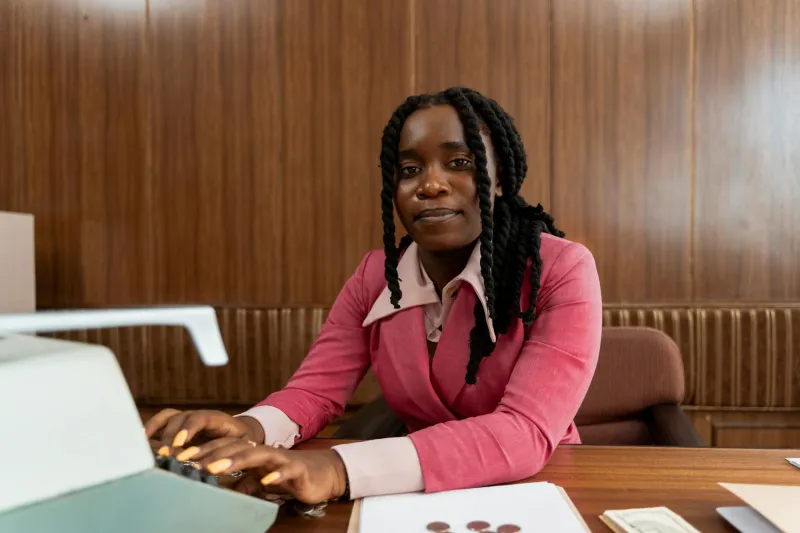
In the pre-email era, secretaries weren't just administrative assistants — they were the living, breathing networks that kept entire companies functioning. A good secretary knew who was in which meeting, which projects were behind schedule, and who needed to talk to whom. They were human routers, directing the flow of information with the precision of air traffic controllers.
The secretarial pool was where much of corporate America's real communication happened. These women (and they were almost exclusively women) would gather around the coffee machine or in the break room, sharing intelligence about office politics, project updates, and executive moods. They knew which vice president was having budget problems, which department was hiring, and which client was threatening to take their business elsewhere.
This informal network was incredibly efficient in ways that no digital system has ever replicated. A good secretary could get you connected to the right person, schedule a meeting that actually worked for everyone involved, and make sure your urgent message reached its destination — all without sending a single email or joining a single video call.
The Lost Art of the Memo
The inter-office memo was corporate America's primary communication tool, and writing one was a skill that required genuine thought and planning. Unlike today's stream-of-consciousness emails, memos were formal documents that followed established protocols: proper headers, clear subject lines, and structured arguments that built to logical conclusions.
Because typing and reproducing memos required real effort — carbon paper, correction fluid, and careful proofreading — writers chose their words carefully. You couldn't just fire off a quick thought and hit send; every memo represented a deliberate communication that someone had invested time and attention in crafting.
The carbon copy system created its own hierarchy of information sharing. The "CC" list at the bottom of a memo told you exactly who else was in the loop, and being included (or excluded) from that list carried real political significance. Getting copied on important memos meant you were considered part of the decision-making process. Being left off suggested you weren't.
When Meetings Actually Mattered
Without the ability to instantly share documents, collaborate in real-time, or send quick clarifying messages, meetings carried much more weight in the pre-digital office. When you called a meeting, you'd better have a good reason — and you'd better come prepared.
Meeting preparation was an elaborate process. Someone (usually a secretary) would type up agendas, make copies, and distribute them in advance. Participants would actually read the materials beforehand because they knew they couldn't just pull up the documents on their laptops during the discussion. The meeting itself was often the first time all the relevant parties could review information together and make collective decisions.
This forced preparation made meetings more focused and productive. Without the distraction of phones and laptops, participants actually listened to each other. Without the ability to instantly fact-check or pull up additional information, discussions stayed on topic. Decisions were made in the room, by the people in the room, based on the information available at that moment.
The Tyranny of Business Hours
Perhaps the most profound difference was that work communication was confined to work hours. When you left the office at 5:30 PM, you were truly disconnected. There were no emails waiting on your phone, no Slack notifications buzzing through dinner, no expectation that you'd respond to urgent requests from home.
This created a natural rhythm to business that we've completely lost. Urgent decisions had to wait until the next business day. Complex negotiations unfolded over days or weeks rather than hours. The pace of business was fundamentally human-scaled, constrained by the physical limitations of paper, phones, and face-to-face meetings.
Interestingly, this slower pace often led to better decisions. Without the pressure to respond immediately, executives had time to think through complex problems, consult with advisors, and consider long-term consequences. The delay built into the system wasn't a bug — it was a feature that prevented hasty decisions and encouraged thoughtful deliberation.
The Social Fabric of the Office
The physical nature of pre-digital communication created more opportunities for casual interaction. Delivering a memo meant walking to someone's office, which might lead to an impromptu conversation about the project. Picking up your mail meant stopping by the mailroom, where you might run into colleagues from other departments.
These chance encounters were the source of much innovation and problem-solving. The sales manager might overhear the production supervisor talking about a delivery delay and realize it would affect a major client. The accounting clerk might mention a budget discrepancy that revealed a larger operational problem. These cross-departmental connections happened naturally in the physical office in ways that our compartmentalized digital workspaces struggle to replicate.
What We Gained and Lost
There's no question that digital communication has made offices more efficient in many ways. Information travels instantly, documents can be shared simultaneously with dozens of people, and decisions that once took weeks can now be made in hours. We can collaborate across time zones, work from anywhere, and access virtually unlimited information at the speed of thought.
But we've also lost something valuable: the deliberate pace that encouraged careful thinking, the physical interactions that built relationships, and the clear boundaries that separated work time from personal time. The pre-digital office forced a kind of mindfulness that our always-on culture has completely abandoned.
Perhaps most importantly, we've lost the shared experience of place. When everyone had to be in the same building to communicate effectively, offices developed distinct cultures and personalities. People knew each other not just as email addresses or Zoom squares, but as whole human beings who you'd see in the elevator, the cafeteria, and the parking lot.
The typewriter-era office wasn't perfect — it was often hierarchical, sometimes inefficient, and certainly less flexible than today's digital workplace. But it operated at a human scale that encouraged relationship-building, careful decision-making, and the kind of deep work that's increasingly difficult to achieve in our hyperconnected age.
In our rush to make everything faster and more efficient, we might have optimized away some of the very things that made work more thoughtful, more social, and ultimately more human.